Showing posts with label animals. Show all posts

Sunday, 19 May 2013

Gerald Durrell, Writer and Animal Collector


The witty and wonderful Gerald Durrell dedicated his life to animal conservation
 
 
Gerald Durrell was an amazing conservationist who collected and studied animals from childhood, went on collecting expeditions for zoos all over the world and finally established his own zoo dedicated to conservation on Jersey.

He was a bestselling author, writing wry, enchanting tales of his animal adventures and is probably best known for the autobiography of his childhood, the Corfu Trilogy.

I grew up reading his books and they had a huge impact on me; not only did they introduce me to so many strange and wonderful creatures but they instilled basic principles of conservation and animal care.

Tuesday, 18 January 2011

Sketchblog: Tree Frogs Saved Me From Twilight

Some apologies for the quality - I don't have a scanner at home, and the lights are really bad, so the photos were awful. When I find my tablet pen (aaargh) I might rescan and colour, if I remember ;D


This is why there are no fairies in the jungle. Tree frogs eat them.


This is why there are no real sparkly vampires. Giant Tree frogs eat them.


Also, I OFFICIALLY DREW A COMIC. 

edit: bwahahaha. I coloured it. With a mouse. In Photoshop, which I don't really know how to use.

...and NOW I see how I could have made the left hand page work better. Damnit.

Monday, 17 January 2011

Sketchblog: Narwhals Are AWESOME

I'm procrastinating on an assignment (about searching, actually - information access stuff) and spent a significant amount of time wandering through Zazzle and selecting Narwhal T-shirts, and carefully mucking around with all the links and code, adding them to one of GreekGeek's templates.

My wrists hurt :D

Anyway, I finally finished, manned up and wrote the introduction, and then went 'doh! Intro image!". I hate using other people's images for the introduction - it's hard to credit, and I have this picture that Is Not Mine staring me in the face all the time. Plus, I've just finished a page about this whole topic so I'm really inspired by it right now. I do this all the time - I can point to at least half a dozen pictures that I mainly drew so that I had something to use on Squidoo, and today's sketch is no exception!

I already complained about not being able to draw digitally this evening - I miss my ArtRage - but all I really needed was a simple sketch, so I whipped out a graphite pencil, found a drawing pad, opened up Google Images and searched 'narwhal' - and voila! Instant Narwhal Picture. I had to muck around in Photoshop a little, cause the lighting where I photographed it is so bad, and because I wrote on it, but I like the result. I'd like it more if I hadn't had to use a nasty mouse to edit, of course...


pencil narwhal sketch

Anyway, one caption and some editing later, and my new lens is complete!
pencil narwhal tee shirt intro image

Monday, 10 January 2011

Eels, Peacocks and Pukekos: Auckland Zoo Again

I went to the Zoo again yesterday afternoon and covered the corner I skipped last time, before my batteries died - apparently videos use them up a lot faster! On the other hand, I barely noticed that I was there three hours, so it may not have been that much faster. I now have a tonne of photos to finish editing - most will go up on the slowly growing Auckland Zoo page.

A lot of animals were sleeping, like the lemurs - but a few appeared to be feeling very lively!


The ring-tailed lemurs were all in a sleepy huddle at the back, so it took a while to find them.


Noisiest animals of the day were definitely the Macaws, peacock and Siamang gibbons.


Creepiest were the eels.
New to me were the several alligators (I thought they only had one, they've got a new exhibit).

This is one of my favourite photos of the day - I like how the reflections seem to go straight through him.

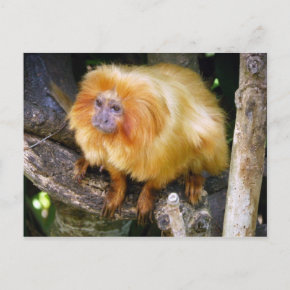
Cutest were the Pukeko chicks and the Golden Lion tamarins.
Off display were all the other tiny monkeys, including the Cotton-topped tamarins, because of rebuilding. The new exhibits look good though.
Saddest was Jane, the old tea party chimpanzee.
Most officious was the Bleeding Heart dove which spent the whole time bustling around on the ground following the Diamond doves and chasing them off whenever they dared land.
Most boring were the wallabies.

Still a lot of people, and still hot - whenever something interesting happened, such as the peacock or the gibbons, an enormous crowd materialised, so I had a lot of trouble getting clear shots. Most of my attempted videos of the gibbons involves lots of bits of people, with a hooting soundtrack! (At least they drowned out the crowd chatter, though, as that was really annoying on other attempts).

I found the eels, in the river just after the Japanese garden. I actually stopped to look at the pair of Pukekos and their little nest of newly hatched chicks and saw an eel being swept down over the weeds. Those babies aren't going to last a week.

One adult Pukeko and two chicks - there's a third running around
but it looked like the runt so probably won't get fed.
Also I love my camera - I was too far away to see
the chicks as anything other than tiny black blobs!

The cluelessness of the birds was demonstrated when one trotted over the log platform/bridge to just under the main traffic bridge and down to the rocks in the shallows to poke around for food.


I saw all the eels emerging, so whipped out my camera, and I caught most of the action...

Behind it, an eel slowly crept up - obviously where they get fed. Closer, closer...


Until it grabbed for the toe of the bird, which jumped back in alarm, as a dozen eels swarmed out (either attracted by blood or the feeding behaviour of the first eel, I don't know).

It escaped, and ran back to the other side, while the eels tumbled and slithered around looking for food.


After a while, they all gave up and retreated back under the banks. Five minutes later the same bird was happily wading back across in the river itself!

I also discovered manual focus and a few other tricks for using the camera at a zoo! I remember the time I first went with my current camera with a friend, and had a lot of trouble with the netting. Well, if you get close enough, and focus far enough away, the wire, bars and nets are either barely visible as an out-of-focus distortion or haze, or not even noticeable!

Also, certain animals are hard to photograph - the eels, because of the reflections on the water (I had to go to the other side and zoom in a lot), the red panda, because the glass is quite hazy and dirty, and the fruitbats and black cockatoos, because I'm not supposed to get close enough to the wire to focus through it.

I had no internet when I got home (a router issue, obviously now sorted!) so I spent the time editing the videos (and sadly they lose SO MUCH quality when shrinking to an uploadable size. But I have to - 50 seconds is 50MB otherwise, and I like not having the internet cut off.)

I managed to grab a shot of the peacock's braying, which I'm pleased with. I'm also highly amused by the song I found for the peacock display video. I had to audioswap half, because of the terrible crowd chatter (some haven't quite worked yet ...)


I didn't see the otters from last time, but I did find the other group, now in the moat on one side of the primate rainforest section (not always there as they hide!).


The golden lion tamarins were very, very, very shiny and golden. There are three and they spent a lot of time freezing in place while they look around quickly at everything... then leaping off into the bushes.

Golden Lion Tamarin postcard
Golden Lion Tamarin by Flynn_the_Cat
Postcards from zazzle.com


I really like the fruit bats, so I was glad to get some kind of recording from them. One large one came down the wire to feed just as I arrived. There are apparently two kinds - the red-headed and the gray flying foxes.


Thursday, 30 December 2010

I Went To Auckland Zoo Yesterday - With My CAMERA

My lovely lovely parents bought me a year's membership for Auckland Zoo for Christmas. Admittedly, it was probably inspired by their recent jaunts (it was getting ridiculous! I'd get a text or phone call and mother would casually mention "Oh, we're at the zoo", but they knew I liked going). So, I went yesterday afternoon to try it out a bit.

The servals were gorgeous, and took turns to come out and pace around. I got my favourite photos of the day with them. So I made postcards (and being useless, that seems to be all I'm making out of my photos lately!)
Stalking Serval postcardServal Standing In Shade postcard
Serval postcardServal postcard
I love the last one - he just looks so annoyed!

On the downside, it was hot, there were many small children, and people speaking in tongues everywhere being in the way and touristy to the point where I had to give up on photos at a couple of exhibits (funnily, one French woman kept ending up at the same exhibits as me!) and sadly, the penguin/shorebird area, the aquarium and aviary are all currently being rebuilt.
I skipped the Walkabout and Primate section entirely, because it was hot, I had a bus to catch in only a couple of hours (the zoo closes at 5.30) and my camera batteries were dying. I hate walking around with no camera! But I didn't mind skipping bits at all, because I fully intend to return at every opportunity (although realising later that the second otter pen was in that area - the one with the family of otters, cause two new ones were born last year - makes me a little sad).

A lot of the animals were hiding or dozing in the heat. The tigers are usually pretty boring as they lurk up the back a lot, but I always go look at them because they are magnificent when they do come out to play. I also always go into the nocturnal Kiwi house because it's right by the entrance - but having been in a dozen or so around the country, and the one at zoo many times, it's completely automatic now and I tend to just keep walking through and straight out again.

I did get really lucky with the otters though! There are two females in a pen next to the tigers and the cafe (with the giant snake slide) and I usually don't see them. But this time when I walked past, they were both playing out the front - one came right up and chirped at people, and the sun on the water made a really good backdrop. The other is one my dad likes (and asked after) - the clockwise otter. She spent about half an hour turning and swimming in clockwise circles! I got a few great photos, too. I noticed later (too busy focusing and playing 'guess where it will jump next' with the camera at the time) that they both have shaved sections on their throats - guess they were visiting the vet!


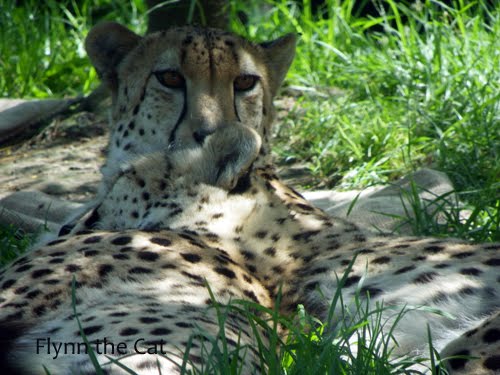
The two cheetah brothers were snuggled up together - one kept putting his head down and wriggling, or curling up in an 'I want to submit this to Lolcats' way, while the other just watched us, and occasionally they both waved the tips of their tails around like big fluffy fans, languidly, in front of their faces.

Ridiculous photo of the day goes to this flamingo. It's all angles and Escher bends!

It was quite interesting actually - all the flamingoes were dozing, and a couple were sitting like this. When they got up, they actually put their heads down and pushed off with their beaks.

Round the corner from the flamingoes (I went out via Pridelands) I ran into two families of tiny chicks, with their mother. They like that area, and seem to come under the fence from the wetlands and poultry section next door. And in the hedge along the lion's enclosure (which I also didn't see) were a couple of pink bottlebrush flowers, which I took the chance to exploit for my token macro images of the day. I was rather pleased with them, actually!

Pink postcardMacro Pink Bottlebrush postcard

Anyway, this led to me trying to put up all my zoo photos into some kind of tour of Auckland Zoo - unfortunately, most of my photos got moved onto my new hard drive last week, which I didn't bring to my parents' house for Christmas! So it's only half done. It is the project that led to me finally reviewing my camera though! (A Pentax X70, if you wondered - ideal for zoo photography!).

Wednesday, 13 October 2010

How I Killed My Brine Shrimp or Why Sea Monkeys Suck

For one of my postgrad Aquaculture assignments we had to raise brine shrimp. Awesome, right? we got all excited in my flat planning to set up a breeding factory and harvest innocent little shrimp for Vexx's fish tank.

Unfortunately this failed epically. Dead brine shrimp, everywhere we looked! So, this is my write-u. Hopefully it will serve as a warning to innocent would-be sea monkey enthusiasts *cruelly destroys optimism*

(EDIT: Apparently my lecturer secretly harbours a dislike of brine shrimp! He gave me an A for killing them all so spectacularly!)

Most useful links:


Raising Brine Shrimp

Brine shrimp in aquaculture

Brine shrimp (Artemia spp., phylum Arthropoda, class Crustacea) are a popular aquaculture live feed species. Live Artemia are one of the only available feeds for many finfish and crustacean larvae. They are the preferred feed due to the ease of preparation and the fact that most species will readily eat them, as well as for their nutritional value. They can be raised both in large scale commercial farms, and by hand at home, by tropical fish enthusiasts. There is investigation into mass production (Zmora et al., 2001) which appears to be highly promising, however many brine shrimp are sourced from a few suppliers.

They are an important food for many commercial species, such as Chinook salmon, lobster and shrimp, and there are numerous studies on the exact effects of brine shrimp diets for these species (e.g. Moore & Strom, 2002). The biochemical composition of the brine shrimp is an important aspect of larval nutrition and numerous enrichment procedures have been developed, or are being researched (e.g. fatty acid uptake to increase the lipid content of the diet (Ritar et al., 2004)).

Feeding live Artemia to fish can bring associated risks of disease and infections via the water they are transported in and the Artemia themselves. The yeast infection of Chinook salmon in Moore & Strom (2002) led to significant levels of mortality (34.5% compared to 4.3%), but was easily fixable by improving handling procedures.


Attempts at hand raising brine shrimp

It is hypothesised that brine shrimp can be raised by hand, at home, based on pre-existing examples.


Methods:
Initially, online research from tropical fish hobbyist forums, where there are numerous discussion about raising brine shrimp for feed, as well as pages such as (1) and (2)

Three different containers were used and several different feed types were planned. The first two containers were 1.5 litre drink bottles, sawn off about 1/3 of the way from the base. They used filtered water from a tropical fish tank. A small aquarium thermometer recorded the temperatures of each batch.

Bottle 1 was an interim experiment while the sealant was drying on Bottle 2. It was a test of naturally growing algal feed. A lettuce leaf was placed in the saline water and left in sunlight for a week before adding the brine shrimp, to allow algae to grow in the water.

Bottle 2 was turned upside down, and a hole was drilled through the lid. A piece of one centimetre plastic tubing was passed through and glued in place with waterproof sealant. After it had dried, and airstone was attached to the inner end of the tube and the bottle was filled with 1L saline water. An air pump was attached to the other end of the tube, and the bottle was propped up inside and insulating styrofoam case (See Figure 1).

Figure 1: Bottle 2 hatchery (Steede, Nyon (n.d.) How to set up a Brine Shrimp hatchery http://www.fryangle.com/Members%20Articles/Brine%20Shrimp.html)

A small glass aquarium tank was used for the third batch. It used to host plants and small fish, and had to be washed clean of gravel, old water and mud. This was filled with 10 litres of tap water and heated with an aquarium heated. The airstone and air pump were recycled from Bottle 2. Feed was a combination of the supplied mix and Brewer’s Yeast.


Results:

Bottle 1 was initially most successful, with continual issues with temperature. The eggs were very slow to hatch, and had to be placed next to an oil heater in an enclosed space under a desk in order to retain enough heat to reach above 20 C due to poor insulation of the building. This meant that they were frequently disturbed by being kicked over, the cat attempting to sit next to the heater, and by the heater being turned off. The high power bill and inconvenient location made this method highly unsuitable. Despite this, a small number of brine shrimp in this container lasted the longest, although that may be due to staggered hatching events.

The brine shrimp appeared to thrive on the algal growth in the water, but died after being left without heat for several hours. Water quality was not as much of an issue with the algal diet, but the design of the bottle meant that it could not be changed easily.

The brine shrimp in Bottle 2 did not hatch after four days, and the temperature stayed at 15ºC. The unhatched eggs were added to the tank, where they then hatched.

The 10L tank was initially the most successful. A small aquarium heater could safely be added, and there was enough water for the airstone to keep the water moving without bubbling too violently. The brine shrimp in this tank hatched in large numbers (estimated 90+% success rate) and survived approximately four days before dying en masse.

Discussion

As none of the brine shrimp made it to adulthood, there were clearly significant issues with the experiments. A number of them are easy to identify as likely causes, specifically temperature, salinity and water quality. It has been found that both temperature and salinity have independent significant effects (at the 99% level) on time to 50% maturity, batch size and number, fecundity, and generation times as well as the lengths of gestation and reproductive life (Wear et al., 1986) All of these concerns are applicable, scaled up, to commercial aquaculture production. It was also difficult occasionally to count the surviving brine shrimp as they were too small to focus on easily. This means that survival times are estimates only. The complete failure of Bottle 2 is most likely because the bottle could not be kept warm enough during winter. Had the shrimp hatched, this design would have been the easiest to feed and clean.


Different containers had different problems, and while the larger tank appeared to allow a higher proportion of the shrimp to live past the two-day mark, it was also much more resource intensive. The bottles were also slightly tricky to set up as the sealant required several days of drying time and came unstuck easily when adding the airstone inside. Equipment quickly became expensive, and budgetary concerns meant that buying several airstones and heaters to test different flows and sizes, or various feeds, was not possible. The tank was borrowed, as was the tubing and sealant glue.

Salinity
Salinity reduces growth and combination of temperature and salinity are the most important factors deciding mortality and growth rates (Figueiredo et al., 2009). The ideal salinity level for Artemia is 30-35psu. Salinity in this experiment was calibrated using an optical refractometer and recommendations from other sources and was approximately 32 psu. It is unlikely this was the issue as Artemia can thrive in a wide range of salinities, and would not have survived even the short time they did in water that was too far out of their tolerance levels. However, the large amount of water and salt needed for the 10L tank meant that supplies of salt were insufficient for regular water changes.

Water quality
For the bottles, previously filtered water could be taken from fish tanks, but for the 10L straight tap water had to be used. Artemia are sensitive to water quality and it is possible this affected them. They shed their skins as they grow, and this needs to be cleared out – water quality can deteriorate within a week or less. Changing the water was extremely difficult for the small tank, especially once the salt ran out.

Feed
Artemia require particulate foods and feed on algae in the wild. Because of the difficulty keeping the shrimp alive, measuring the effects of different feeds was not feasible or reliable. Their maternal supply of food ensures that most of the shrimp survived the first couple of days. For Bottle 1, the algae in the water appeared to be sufficient. For the tank, too much feed led to deteriorating water quality, which contributed to the failure of one batch. Possible feeds include any non-dissolving particulate matter, such as yeast, whey, wheat flour, dried algae, soybean powder, fish meal and egg yolk (Wikihow, n.d.;) and it is possible to create special feeds (e.g. Bill "Pegasus NZ", n.d.).

Temperature
Temperature is one of the major factors in mortality and growth rates (Figueiredo et al., 2009). It was found that brine shrimp have a required hatching temperature of about 25ºC and usually hatch within 24 hours after adding the eggs to salt water. Maintaining this temperature was the major problem, as the ambient temperature was around 15ºC during daytime, and lower at night. Plastic bottles are difficult to heat and insulate safely, especially in winter and it had an obvious and immediate effect on the survival of the shrimp, with delayed hatching times at colder temperatures.

Oxygen levels and aeration
Strong aeration is also very important, for both oxygen levels and habitat. Brine shrimp can swallow small bubbles forcing them to float (Bischof, n.d.), and will sink without light to attract them or strong turbulence (Wikihow, n.d.).

Bottle 1 did not have an air supply, but possibly the turbulence from being repeatedly kicked or knocked over supplied the shrimp with enough oxygen. The low level of surviving water meant that a greater proportion of the water was in contact with air, which probably also helped with oxygen levels.

The air supply from the airstone was also much too strong when used in Bottle 2 and pushed all the eggs over a centimetre above the water level. It was ideal in the tank, but the brine shrimp tended to get trapped in corners.

pH
While brine shrimp prefer a pH of around 8.0 (Bischof, n.d.) there was no way to test this. Had it been testable, it could have been corrected using baking soda

Lighting
Light levels may have had an effect, as Bottle 1 was kept in near-darkness, while the other two methods were on natural day-night lighting (as recommended by Wikihow, n.d.). Brine shrimp are attracted to light, which meant that they could be attracted to one end by shining a torch, making it easier to change the water. It also means they can expend too much energy trying to reach bright lights (Bischof, n.d.)
Different authors recommend either light or dark (Bill "Pegasus NZ", n.d.), but this contradiction was unable to be tested properly due to the short lifespans of the shrimp – and the lack of spare lamps to put near the bottles (although this would also have provided an inefficient additional source of heat and could be worth investigating).


Conclusion

While brine shrimp can be raised by hobbyists, and are in widespread production, they require a careful set-up and some experience. There are advanced set-ups of increasing scale available to investigate, but each hobby breeder appears to have a different method. They are a very important part of commercial aquaculture feed, and there is ongoing research into improving the consistency of supply and nutritional value.

References

Bill "Pegasus NZ" (n.d.) Raising And Growing Large Brine Shrimp. Retrieved from http://www.aquarticles.com/articles/management/Pegasus_Brine_Shrimp.htmlBischof, B. (n.d.) How to Raise Brine Shrimp. Retrieved from http://www.petplace.com/fish/how-to-raise-brine-shrimp/page1.aspx Figueiredo, J., van Woesik, R., Lin, J. & Narciso, L. (2009).  Artemia franciscana enrichment model -- How to keep them small, rich and alive? Aquaculture, 294( 3-4): 212-220KS@Lilly.com (1995) Artemia (Brine Shrimp) FAQ 1.1. Retrieved from http://web.cecs.pdx.edu/~davidr/discus/articles/artemia.htmlLavens, P. & Sorgeloos, P. (2000). The history, present status and prospects of the availability of Artemia cysts for aquaculture. Aquaculture, 181: 397–403
Lavens, P. & Sorgeloos, P. (2000) The history, present status and prospects of the availability of Artemia cysts for aquaculture. Aquaculture, 181: 397–403

Léger, P. & Sorgeloos, P. (1992). Optimized feeding regimes in shrimp hatcheries. In: Fast, A.W., Lester, L.J. (Eds.). Marine Shrimp Culture: Principles and Practices. Elsevier, New York, pp. 225–244.

Lenz, P.H. (1987). Ecological studies on Artemia: a review. In: Sorgeloos, P., Bengston, D.A., Declier, W., Jaspers, E. (Eds.), Artemia Research and Its Application. Ecology, Culturing, Use in Aquaculture, vol. 3. Universa Press, Wetteren, Belgium, pp. 5 –18.

Persoone, G. & Sorgeloos, P. (1980). General aspects of ecology and biogeography of Artemia. In: Persoone, G., Sorgeloos, P., Roels, O., Jaspers, E. (Eds.), The Brine Shrimps Artemia. Ecology, Culturing, Use in Aquaculture, vol. 3. Universa Press, Wetteren, Belgium, pp. 3– 24.
Ritar, A. J., Dunstan, G. A., Nelson, M. M., Brown, M. R., Nichols, P.D. Thomas, C. W., Smith, E. G.,
Crear, B. J. & Kolkovski, S.  (2004). Nutritional and bacterial profiles of juvenile Artemia fed different
enrichments and during starvation, Aquaculture, 239(1-4):  351-373

Steede, Nyon (n.d.) How to set up a Brine Shrimp hatchery. Retrieved from http://www.fryangle.com/Members%20Articles/Brine%20Shrimp.html)

Wear, R.G., Haslett, S.J. & Alexander, N. L. (1986). Effects of temperature and salinity on the biology of Artemia fransiscana Kellogg from Lake Grassmere, New Zealand. 2. Maturation, fecundity, and generation times, Journal of Experimental Marine Biology and Ecology, 98(1-2): 167-183

Wikihow (n.d.) How to Raise Brine Shrimp. Retrieved from http://www.wikihow.com/Raise-Brine-Shrimp
Zmora, O., Avital, E. & Gordin, H. (2002). Results of an attempt for mass production of Artemia in extensive ponds. Aquaculture, 213: 395–400

Friday, 8 October 2010

Duckling Shooting Season


Walked through the Auckland Domain today, camera in tow, and found three families of ducklings. Two mallard families and one pair of paradise duck ducklings. So I photographed them all and videoed the mallards. And now I'm figuring out YouTube...


One of the ducklings was lame...


Wednesday, 29 September 2010

Took The Cat To The Vet Today

moss cat pet happy senior tortoiseshell-white
Just got back from the vet with the cat. She promptly lay down on the driveway and demanded food (more or less in that order!). She's been on my mind a bit these last couple of days, hence the amount of writing about her I am doing. She's my dependent :D And I vastly prefer her over both a kitten and a child (the first is crunchy, the second gets you in legal trouble if you cook it).

This is the third time in her life that she's ever been to the vets - once as a kitten for the uterine-excavation-operation-of-doom, once a few years back for flea allergies and then again to the same vet today. She's thirteen (minus an estimated month). So it was a rare and special occasion for both of us.

Ah, and here she comes. Mewing and chirruping. Because, obviously, she ran out of food. And my bag is in her spot on the bed, so she's standing there and calling me over to pay attention to her, and fix it damn it, these bones need a comfy spot!

She's got some kind of intestinal bleeding, which leads to extremely smelly stools, black with digested blood. Which led to panic in the flat on their discovery in the litterbox, and I got to research various gross things on the internet (and poor Arkillian was driven away from the couch by the smell). So now I have to sneak antibiotics and stomach-lining stuff down her throat everyday for the next week... and to try and persuade her that outdoors is so much nicer than the litterbox. Really. Even when it's wet and cold and has stray cats nearly as big as her.

Got some supplements (Seaflex) for her arthritic joints, so she can stop limping and being miserable everytime it rains. And growling at me when I pick her up, that's important too... as it can lead to biting. Luckily she thinks they're cat treats.

Otherwise she's very healthy, weighs 4.44 kg (she lost nearly a whole kilogram when she was sick!) and happily shed all over me. The cat brush was buried under the pile of computers from the LAN Diablo 2 character creating event in the sitting room... I had to dig it out and drag another handful out of her fur when we got back.

She's funny - I don't know if all cats do this, but when she's in the carrier in the car she meows very pitifully - these long, moaning, wails, sort of 'whyyyyyy?'. She's very well behaved - and we actually let her out on the way back (it was Mum's idea. I'm not quite sure what she was thinking, but I was greatly entertained, so I don't regret it. The cat was loose in the car on the ride up from Hamilton ten years ago, so there was precedent...)

The cat promptly ran and stood up on the side door, looking out the window, then came through the seats into the front, and I diverted her onto the passenger side. She sat on my lap awhile, and wanted to climb onto the dashboard and shed profusely in vengeance at being denied. Then she went in the back and stood against the door, watching dreary Auckland roads go by, then climbed up and lay on the back dashboard area. At which point we decided that she should probably go back in the box.

Then she climbed down and lay on the seat, looking between the front seats at the view, and then she realised there was another side door that she hadn't looked out of, so she went to do that, and managed to stand on the automatic window button. Which led to great panic, and probably great interest on her part, as the window went down... and we promptly pulled over and poured her back into her carrier, and she "MAOOOOOOOW"ed her way home. Where she commenced to be quite happy and most demanding as soon as she was let out.


Edit: Hey, cool - vet follow-up. Just got a phonecall from the vet, with more care tips (bland diet and so on) for the next week, in case she did poison or injure herself. Cat spent the entire phonecall headbutting me in the knees and mewing for attention.

Breaking News: Three Kittens Created From Cat Fur

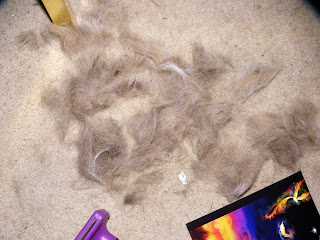
....well, no. Not really. But only because I didn't have the patience to create them. Summer arrived over the weekend here in New Zealand and my cat took that as a sign to shed her entire undercoat in a day. I come innocently home from visiting my parents over the weekend, pick up the cat brush (the really awesome FURminator) to bond and get rid of any stray loose fur. Sweep it through, watch in surprise at the large clumps of puffing fur at the end of the first stroke...


And an entire kitten emerges.

cat fur carpet furminator shedding undercoat soft

I swear, I got three kittens worth of fur out of her. I made balls out of them, and even squashed down, they each filled my hand. I threw the first one away (after showing it off), took pictures of the second lot (she was a very obliging model), then discovered still more later. Then the cat got grumpy :D
moss old cat senior brush groom fur pile furminator

Now I have to decide. What shall I do with all this fur? I could make a kitten, but they tend to be a nuisance. I could make fake beards and wigs to sell. But a lot of people are allergic to cat fur (and I don't know how to make a fake beard). On the other hand, it's the skin and dander that people are actually allergic too - maybe I can microwave it, rub my face in it and see if it makes me sneeze.

I could stuff a pillow, or sell it to birds to make their nests. Or line my increasingly holey shoes!

Sunday, 22 August 2010

The (Real) Cat Returns


The real, furry, purring cat, that is.

I brought my cat back to my flat again this evening - she seems to remember it, which is good, and is following me around and lying on the floor everywhere. She just climbed up on the chest of drawers, until blocked by the large box of paints, and wriggled her head under the curtain so she could sit and look out into the dark...

She's a good cat, and a very good natured one - she's nearly thirteen now! Unfortunately, she's very, very, very furry and sheds a lot.

Anyway, I'm looking forward to having a cat on my bed again, to keep me warm, and to come and say hello when I get home. I'll have to pick up some nice catfood for her though. Before she decides to do more than just nibble my fingers...

Friday, 20 August 2010

Cats on the Trampoline

When I was younger, we had a huge trampoline and it was great fun. I also had a cat (which I still have). Appparently the site of my feet flying up and down was irrestible, she'd leap up, and throw herself at my legs, in an attempt to either capture them or love me to death, depending on her mood. I inevitably would be in midair, and come back down to send her three feet in the air.

Apparently that was fun, because it usually inspired an attempt to eat me. I had to slow down, stroke her, and persuade her that I was not a toy, and she can get off now!

In light of that memory, have some trampoling cat videos :D (happy cats only, I don't approve of the ones where the cat's only been put there to be bounced for the camera)